
Jaime Zamorano, Director Técnico Gelymar
Jaime Zamorano, Technical Director at Gelymar, is the author of Chapter 7 of Advances in Temperate Phyconomy (Springer, 2026), an analysis of the Chilean red seaweed system: which species sustain the industry, why cold-water carrageenans are different, and what needs to change for the model to remain viable.
When carrageenan comes up, the global conversation tends to look towards the tropics. There is, however, a second story — colder, further south and far less often told — unfolding along the coasts of Chile. It is the story that Jaime Zamorano, Technical Director at Gelymar and a marine biologist with over 30 years of experience in the study, cultivation and industrial processing of seaweeds, has set out in a new academic chapter published by Springer Nature.
The chapter is titled Phyconomic Aspects of Red Seaweeds (Rhodophyta) from Cold and Temperate Regions Used as Raw Materials for Hydrocolloid Production (e.g., Agars and Carrageenans): Examples from Chile, and it forms part of the volume Advances in Temperate Phyconomy: Algal Harvest and Cultivation in Globally Distributed Temperate Waters, edited by A. T. Critchley and colleagues within the Developments in Applied Phycology series.
For us, this publication carries a twofold value: it offers a rigorous picture of the industry we have worked in for more than 35 years and, at the same time, sets out with hard data why cold-water red seaweeds hold a place that no other raw material can fill.
What phyconomy is, and why Chile works differently
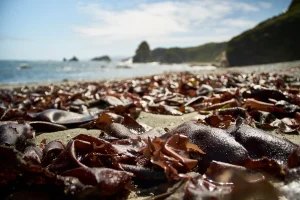
The concept of phyconomy emerged in connection with large-scale seaweed cultivation, primarily in tropical waters. The chapter introduces a necessary distinction: in cold and temperate regions such as Chile, the activity does not rest on mass cultivation but on the harvesting of wild populations. That changes the biological, economic and social equation entirely.
Chile is one of the few countries producing high-quality raw materials for both agars and carrageenans. While agars are derived from cultivated and wild seaweeds, carrageenans are obtained almost exclusively from wild-harvested biomass.
The species that sustain the Chilean industry
The chapter maps national production using 2024 figures from Sernapesca, Chile’s national fisheries service. On the agarophyte side, Gracilaria chilensis dominates the activity with 60,376 tonnes of artisanal landings, to which a further 11,267 tonnes recorded as aquaculture must be added.
Among the carrageenophytes, two species are clearly dominant:
- Sarcothalia crispata: 24,331 tonnes
- Sarcopeltis skottsbergii: 24,122 tonnes
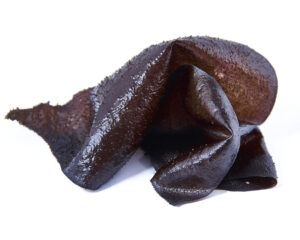
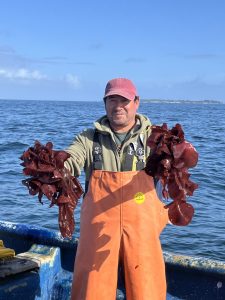
Sarcothalia crispata
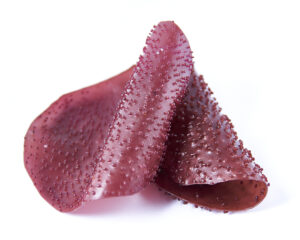
Sarcopelis Skottsbergii
Further behind come Mazzaella laminarioides, Chondracanthus canaliculatus, Chondracanthus chamissoi and Gelidium spp. Taken together, between 2014 and 2024 total landings of agarophytes and carrageenophytes have ranged from 98,000 to 138,000 tonnes of wet weight per year — three decades of stability that the chapter itself reads as a sign of the resource’s sustainability.
Harvesting also follows a strongly seasonal pattern. Peaks occur between mid-spring in the Southern Hemisphere — around October — and mid-autumn, with maxima in the summer months, from December to March.
Kappa-2 and lambda: what only cold waters deliver
Here, in our view, lies the technical heart of the work. Cold-water red seaweeds evolved producing carrageenan types that are structurally different from their tropical counterparts, and that difference translates directly into functionality.
Kappa-2 carrageenan is a copolymer that combines the properties of kappa and iota. It forms thermo-reversible gels with an intermediate elasticity, sitting between the firm, brittle gel of pure kappa and the weak, elastic gel of iota. Unlike commercial blends of kappa and iota, hybrid gels show no syneresis — that is, they do not exude water during gelation. In dairy applications it interacts with casein, providing stabilisation and a distinctive mouthfeel; in meat products it interacts with proteins — particularly myosin — improving water retention, juiciness and ease of slicing.
Lambda carrageenan, for its part, does not gel: it delivers high viscosity, is cold-soluble, and its behaviour is less affected by the presence of sugars or salts. Notably, most of the lambda produced worldwide comes from Chilean species.
The chapter also explains the biological mechanism behind this: in the Gigartinaceae family, the type of carrageenan depends on the ploidy of the thallus. Gametophytes produce carrageenans of the kappa family and tetrasporophytes those of the lambda family. One resource, two functionally distinct products.
Yield adds to the picture. S. skottsbergii reaches around 50% carrageenan on a dry weight basis and S. crispata around 40%, against the 20–25% typical of other industrial carrageenophyte sources.
A value chain with names attached
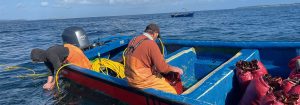
 One of the chapter’s most distinctive contributions is its socio-economic analysis. In Chile, only registered artisanal fishers, divers and shoreline gatherers may legally harvest seaweeds, under the sustainable management framework of Law 21,651 of 2024.
Depending on the hydrocolloid, between 60% and 80% of the export value is paid directly to these harvesters — a marked contrast with what seaweed farmers receive in the tropics. For coastal communities, harvesting and selling dried red seaweeds works as a safety net against the seasonality of other fisheries.
The chapter also records a gender dimension that is rarely documented: intertidal harvesting of species such as Sarcothalia crispata and Mazzaella laminarioides sees significant participation by women, whereas subtidal harvesting of Sarcopeltis skottsbergii is carried out exclusively by men. In isolated territories such as the Chiloé Archipelago, this is the activity that connects local economies to global phycocolloid markets.
Why this work matters
The Humboldt Current keeps the waters along the entire Chilean coast cold and creates the conditions that protect this macroalgal biomass. On that natural foundation an industry was built — with history, species diversity and a real social impact on the communities that sustain it.
Jaime Zamorano’s chapter puts that whole system on the table — biology, chemistry, economics and territory — and leaves one idea clear: innovation, responsible management and integrated marine ecosystem policies will define the future of this industry in Chile. That is precisely the conversation we at Gelymar want to help sustain.
PUBLICATION DETAILS
Zamorano, J. (2026). Phyconomic Aspects of Red Seaweeds (Rhodophyta) from Cold and Temperate Regions Used as Raw Materials for Hydrocolloid Production (e.g., Agars and Carrageenans): Examples from Chile. In A. T. Critchley et al. (eds.), Advances in Temperate Phyconomy: Algal Harvest and Cultivation in Globally Distributed Temperate Waters. Developments in Applied Phycology, vol. 16. Springer Nature Switzerland, pp. 131–142. DOI: 10.1007/978-3-032-28281-1_7